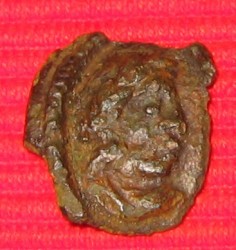
Romeins Ring fragment hoofd.
 Afmeting: 2.5 cm.
Periode: 0 tot 400 n.Chr.
 The upper side of one Roman ring fragment, picture of a boy.
Period: approximately 1st-4th century A.D.
One find in the Batavian city of Nijmegen (noviomagus) - the Netherlands - Europe
An Etruscan boy and his duck.
In 1746, a farmer from Montecchio, a little village near the city of Cortona in Toscany, found four
bronze objects while he was planting olive trees. The artefacts turned out to be exquisite, age-old
Etruscan statuettes. Objects like these were commonly found in the region. The priest of Montecchio
used these ‘pagan’ finds for casting church bells. But the farmer was particularly fond of the statuette
of a boy and a duck, and decided to sell it to a collector from Cortona. The Etruscans were adept at casting
bronze. This statuette of a boy holding a duck stands out because of the carefully worked details. The text
engraved in the right leg proves the statuette was dedicated to the goddess Thufltha. Probably, the boy’s mother
ordered the statuette to be cast, so that her son could be assured of good health.

Dating from: 200-100 B.C., material: bronze,
height: 55 cm, origin: Montecchio (Italy)
Terug